Design & Appearance
The NX11 looks nearly identical to its predecessor, the Samsung NX10. It supports the same mirrorless SLR design that makes for a compact shooting experience (compared to a traditional DSLR, that is). It also has the same 3-inch LCD on the back, but it features an improved rounded grip on the front. Like the NX10, the NX11 is a good mid-range size that is small enough to carry with you to most events without much complaint, but large enough to retain the aura of professionalism that only a DSLR can provide.
Tour
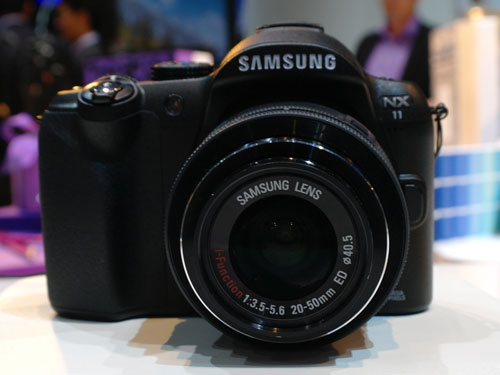
The NX11 uses Samsung's NX lens mount for its interchangeable lens system.
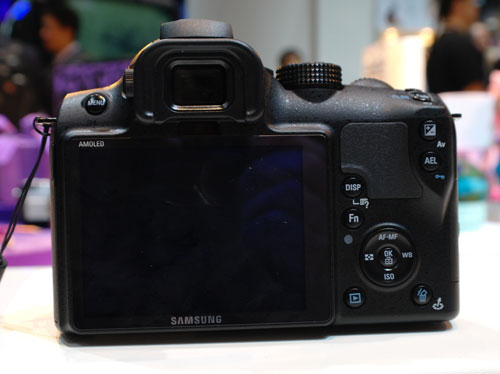
The camera has a 3-inch LCD and a viewfinder.
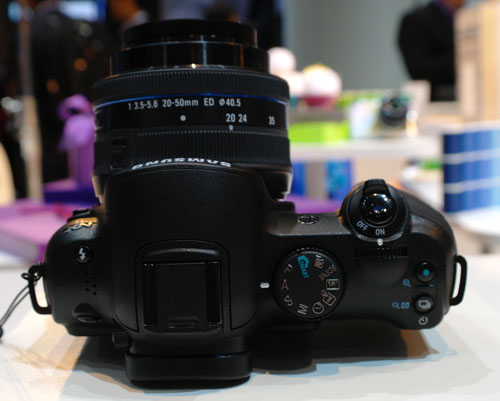
You can get a good idea of the camera's thickness with this top image.
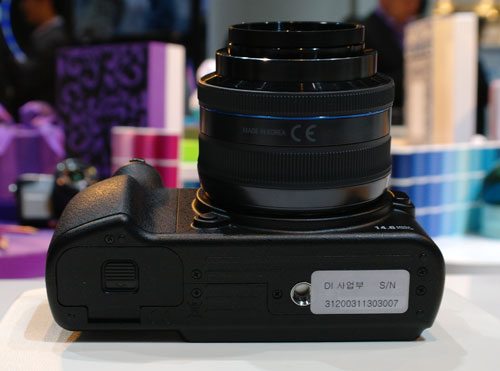
The bottom has the battery compartment and tripod mount.
Viewfinder
The NX11 has a well-sized electronic viewfinder that sits just above the LCD on the back of the camera. The viewfinder has a 640 × 480 (VGA) resolution and is surrounded by a small eyepiece that isn’t especially comfortable. A sensor below the viewfinder can be turned on to automatically detect whether the viewfinder or LCD should be active. For example, when you put your eye up to the viewfinder, the LCD will shut off automatically if the sensor is turned on. This feature can be annoying, however, particularly if you are constantly moving your hands in front of the sensor (you can turn the sensor off to avoid this problem).
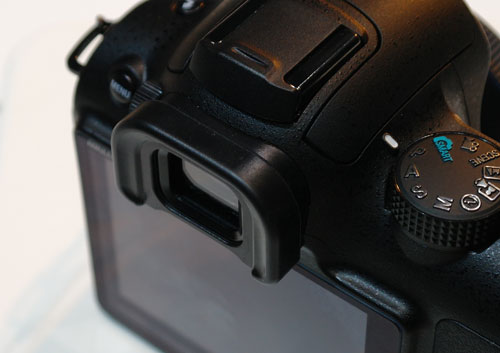
Many users may prefer the LCD, but the viewfinder is great for old-school photographers.
LCD
The LCD on the NX11 appears to be the same screen that Samsung employed on the NX10. It is 3-inches diagonally and has a 614,000- pixel resolution. It also has an AMOLED design (active matrix OLED) that is said to reduce glare under sunny conditions.
While this LCD is good for basic shooting, we wish Samsung would include a tiltable element to the screen on the NX11. It would certainly be a tremendous boost for video recording, which is a key feature of the NX11.
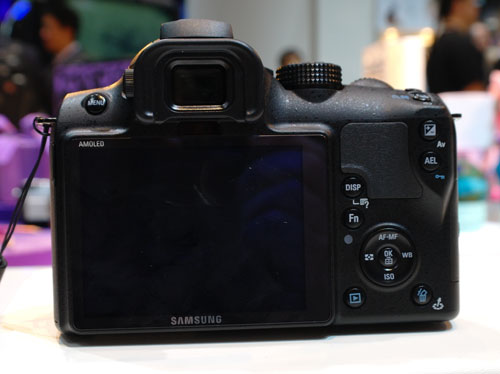
The 3-inch LCD is a good size, but we wish it could rotate or tilt.
Flash
A pop-up flash is located on the top of the NX11, just like we saw on the NX10 (but something that was absent on the NX100). We couldn’t test the flash very efficiently, but we weren’t very impressed with its intensity. We saw the same problem with the flash on the NX10.
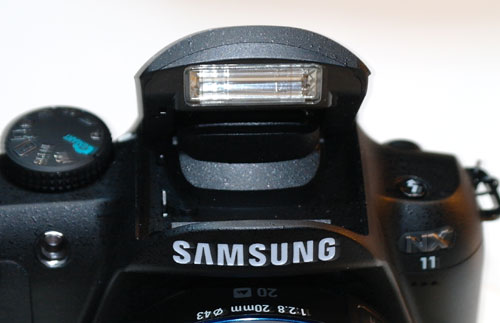
The pop-up flash makes an appearance when you press the flash button on the top of the camera.
Lens Mount & Sensor
The NX lens mount is fairly new for Samsung, as it was introduced last year on the Samsung NX10. Over time, more lenses have become available that fit the NX mount, which makes owning an NX camera more versatile than ever before. Like the NX100, the NX11 is compatible with i-Function lenses that allow you to control things like shutter speed and aperture using the camera’s lens ring. With a firmware upgrade on the NX100, i-Function capability can also be available on that model. Currently, there are two i-Function lenses available in addition to the 18 – 55mm lens that comes with the NX11. They new lenses are a 20mm f/2.8 pancake style lens and a 20 – 55mm f/3.5 zoom lens.
The sensor on the NX11 is unchanged from what Samsung used on its NX10 last year. This means its the same 14.6 megapixel CMOS sensor with dimensions of 23.4 × 15.6mm. Identical sensors usually mean similar image performance, so if you’re expecting better picture quality from the NX11 (compared to the NX10), you’re likely to be disappointed.
Jacks, Ports & Plugs
All the ports on the NX11 are located on the left side of the camera behind a flip-open door. There’s also an accessory shoe on the top of the camera for attaching an external flash, light, etc. The USB port on the camera is proprietary and it doubles as an AV-out port, which is fairly annoying. The NX11 should ship with a USB cable, but we don’t know if the camera comes with a proprietary AV cable (the NX10 didn’t and it bothered us greatly).
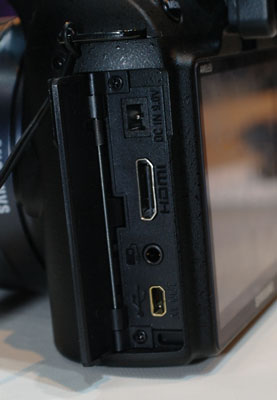
The ports on the left side (from top to bottom): DC-input, HDMI, remote, USB.
Battery
The battery on the NX11 has a normal, rectangular shape and it fits into a compartment on the bottom of the camera. The compartment is protected well and the battery stays put thanks to a little locking mechanism that holds it in place.
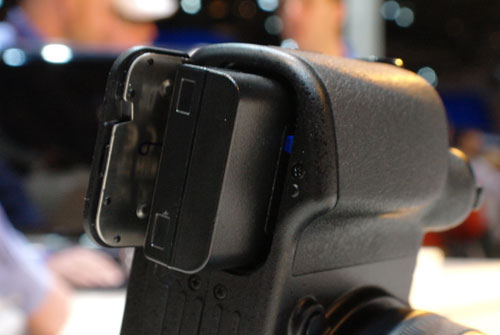
The battery compartment is on the bottom of the camera.
Memory
The NX11 works with SD/SDHC memory cards via a card slot on the right side of the camera. There’s no internal memory on the model, so make sure you purchase a memory card before taking the NX11 out for a night on the town.
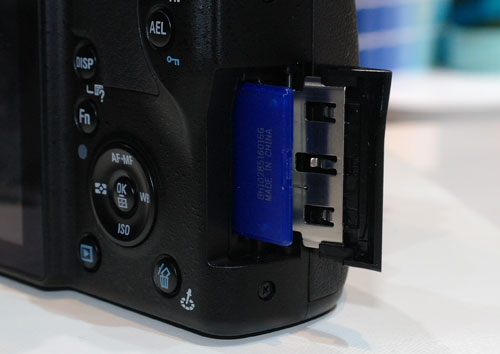
The SD memory card slot is on the right side of the camera
Size & Handling
The NX11 has identical dimensions and weight as the Samsung NX10 (its predecessor). If you don’t have these dimensions memorized, here they are again: 123 × 87 × 40mm and a weight of 353g without the battery. This is a generous size for a mirrorless interchangeable lens camera, but it is certainly a whole lot lighter and more compact than a traditional DSLR. Basically, you wouldn’t want to get the NX11 if you’re looking for the smallest camera that will allow you to switch lenses. But, if you don’t mind a slight amount of bulk and professionalism, the NX11 should be the perfect size for your needs.
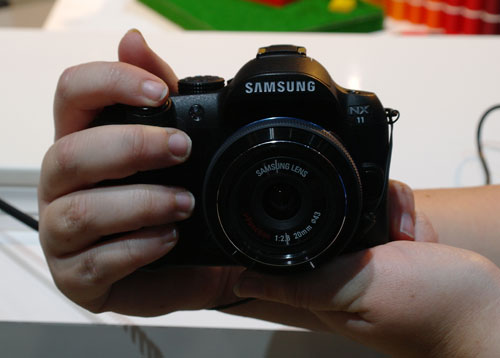
The right side grip is accommodating for both large and small hands.
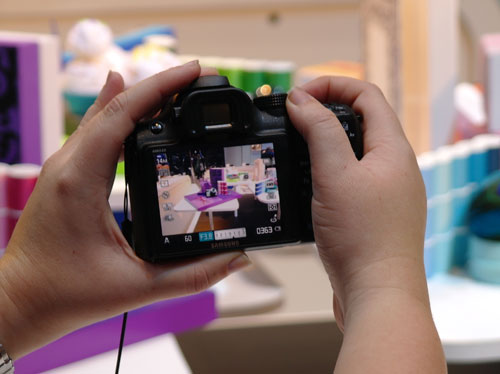
The NX11 isn't quite small enough to hold comfortably with one hand.
Ease of Use
Since the NX11 is essentially a “bridge” camera between point-and-shoots and high-end DSLRs, it fits into an interesting niche as far as ease of use is concerned. You can definitely work with the camera in auto mode using Samsung’s Smart Auto controls, but how much fun would this really be? Isn’t the point of getting a powerful camera like the NX11 so you can play with all its nifty manual controls and features?
The NX11 makes doing this even easier with its i-Function lens that puts manual adjustments at your fingertips. Rotating the lens ring allows you to adjust aperture, shutter speed and ISO without having to move your hand from the base of the lens. It works extremely well and it makes you feel like a top-notch professional. Adjusting controls on the fly couldn’t be much easier than with Samsung’s i-Function lens system.
The camera does, however, have a long and somewhat confusing menu, although we do like its layout and easy-to-read setup. We complained about the instruction manual for the NX10, as it was often poorly worded and badly translated. Hopefully, Samsung did some better proofreading with the NX11.
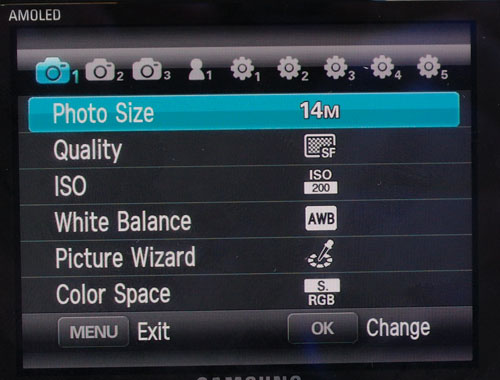
The main menu is organized in many parts
Auto Mode
The NX11 does a decent job in auto mode, but we weren’t always impressed with the camera’s autofocus mechanism. It simply didn’t work a few times when we tried it out at CES, but, we must admit, this was in low light situations where cameras often have trouble with focus. The Smart Auto was occasionally spot-on with selecting the correct scene mode for our shooting situation, but it also missed the mark a number of times as well. Our recommendation: use Smart Auto sparingly, like when you don’t have time to set controls manually.
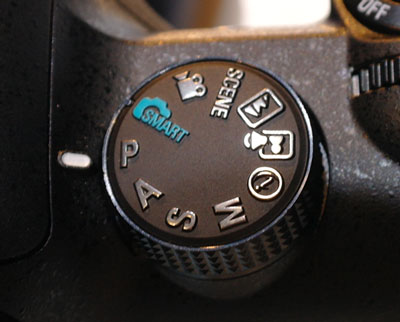
The Smart Auto mode is an option on the camera's mode dial.
Movie Mode
You can shoot 720p HD video with the NX11 and the camera has the same video mode options that are present on the NX10. That being said, we haven’t been very impressed with Samsung’s video performance from its set of video-capable DSLRs. Since the NX11 has the same sensor as the NX10, it is likely that we’ll be similarly disappointed.
One advantage, though, is Samsung’s new video-specific NX lens that will work with the NX11. This lens allows for better autofocus performance when recording video. We’ve even tried it out and it works surprisingly well—nearly as good as the autofocus on regular consumer camcorders.
Drive/Burst Mode
The burst mode on the NX11 worked decently when we fooled around with it at CES, but this opinion is not based on any kind of official test. In our testing of the NX10, we were unimpressed by the camera’s burst mode (it came it at around 3 photos/sec). It should be safe to say the NX11 will obtain similar results when we bring it into our labs.
Playback Mode
The NX11 has a basic playback mode that involves selecting thumbnails on the LCD. For video playback, the camera has a mini-HDMI output, which is great for watching clips on an HDTV. Unfortunately, the AV-out port is proprietary (and the camera may or may not come with a compatible cable). So, if you want to watch your videos or photos on a regular TV, you may have to contact Samsung and buy an AV cable first.
Other Modes
Panorama
One of the new features on the NX11 is a panorama mode that utilizes a “press-and-sweep” function to allow you to capture large panoramic shots. The function appeared to work quite well when we tried it out on the floor at CES, but panorama modes certainly aren’t for everybody.
Manual Controls
The NX11 has a full set of manual controls and the big new feature on the camera is its i-Function lens compatibility. This feature is also available on the NX10 (with a firmware upgrade) and the NX100 from Samsung. So, what is i-Function? It is the ability for you to control shutter speed, aperture, exposure, white balance, and ISO by using the lens ring on the camera’s lens. You do, of course, need a compatible i-Function lens attached to do this, but the NX11 does come with one as its kit lens.
Focus
Focus can always be set manually using the lens ring on any lens attached to the NX11—even lenses without i-Function capability. The camera has a focus zoom assist that we weren’t too crazy about, but it does help you see whether you’re actually bringing your image into focus. We found the lens ring on the NX11’s kit lens to be a bit too loose for proper focus adjustment overall. We’d like to see a ring with a bit more friction, as that would allow for a more precise focus adjustment.
ISO
ISO is one of the controls that can be set using the i-Function feature. The camera can also be set to automatic ISO adjustment at any point.
White Balance
Get ready for a boatload of white balance presets on the NX11. The camera offers the following options: Auto, Daylight, Cloudy, Fluorescent White, Fluorescent Daylight, Tungsten, Flash, Custom, and Kelvin Color Temp. We weren’t always confident in the camera’s auto white balance system, as it occasionally produced bad results. Most of the time it worked adequately if you gave it time, though.
Exposure & Metering
Exposure is another control that can be adjusted with the i-Function lens feature. The exposure range is -3 to +3 in 1/3 or 1/2 EV increments. The camera also has an auto exposure bracketing feature that takes a 3-shot sequence with a +/-3 EV range.
Shutter Speed
Shutter speed can be set with the i-Function feature and it can be controlled manually in Shutter Priority or Manual mode. The shutter speed range goes from 1/4000 of a second to 30 seconds, as well as a bulb option that can leave the shutter open for as long as 8 minutes.
Aperture
Aperture has the same level of manual control as shutter speed on the NX11. You can set it in Aperture Priority mode or Manual mode. The aperture values available on the camera are entirely dependent on what kind of lens is attached.
Image Stabilization
Stabilization is available on the NX11, but it whether or not it is available depends on what lens you have attached to the camera.
Picture Quality & Size Options
The largest photo size option on the NX11 is a 14-megapixel setting that takes photos at a resolution of 4592 × 3056. The camera also has 12-megapixel, 10-megapixel, 8-megapixel, 6-megapixel, 5-megapixel, and 2-megapixel photo size options. There are options for both 3:2 and 16:9 aspect ratios as well.
Picture Effects
The camera has picture effects called Standard, Vivid, Portrait, Landscape, Forest, Retro, Cool, Calm, and Classic.
Conclusion
The Samsung NX11 may very well be an excellent camera, but the fact that it lacks any impressive updates or exciting new features leaves us a bit disappointed. The camera offers very little to set it apart from last year’s NX10, as the only new features implemented by Samsung are the panorama photo option and the i-Function lens compatibility. The thing is, i-Function compatibility is also available on the NX10 via a firmware upgrade, so if you have the NX10 there’s no compelling reason to upgrade to the NX11.
Despite all this, we do like many aspects of the NX11. The i-Function lens feature is excellent for people who love to adjust manual controls on the fly, and the camera’s compact design is neither too big nor too small. The video mode probably won’t blow anyone away, but with an asking price of around $650, the Samsung NX11 won’t hit you incredibly hard in the wallet. It may be a decent choice for someone who is looking to experiment with a video mode on an interchangeable lens camera. It certainly fits the niche for someone looking to upgrade over their point-and-shoot device onto a more powerful camera.
Photo Gallery
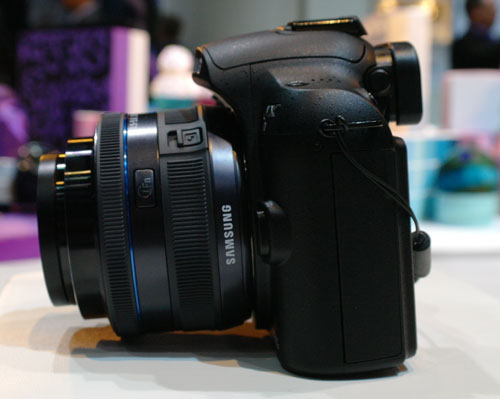
The left side houses some ports and terminals.
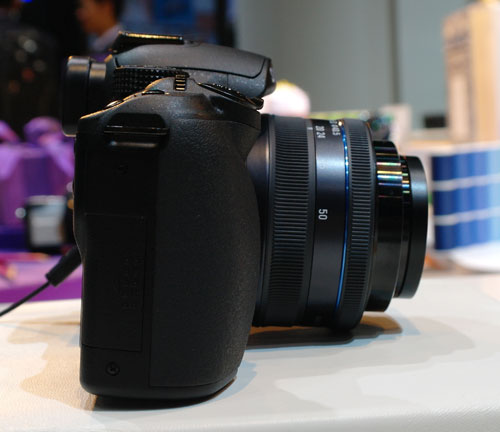
The right has a good, rounded grip that works quite well.


 Although details aren't one hundred percent concrete as to exact product releases, all paths point to the development of Samsung's NX series into a more rounded, complete and, we suspect, professional solution. Although there are only three UK camera bodies - the